

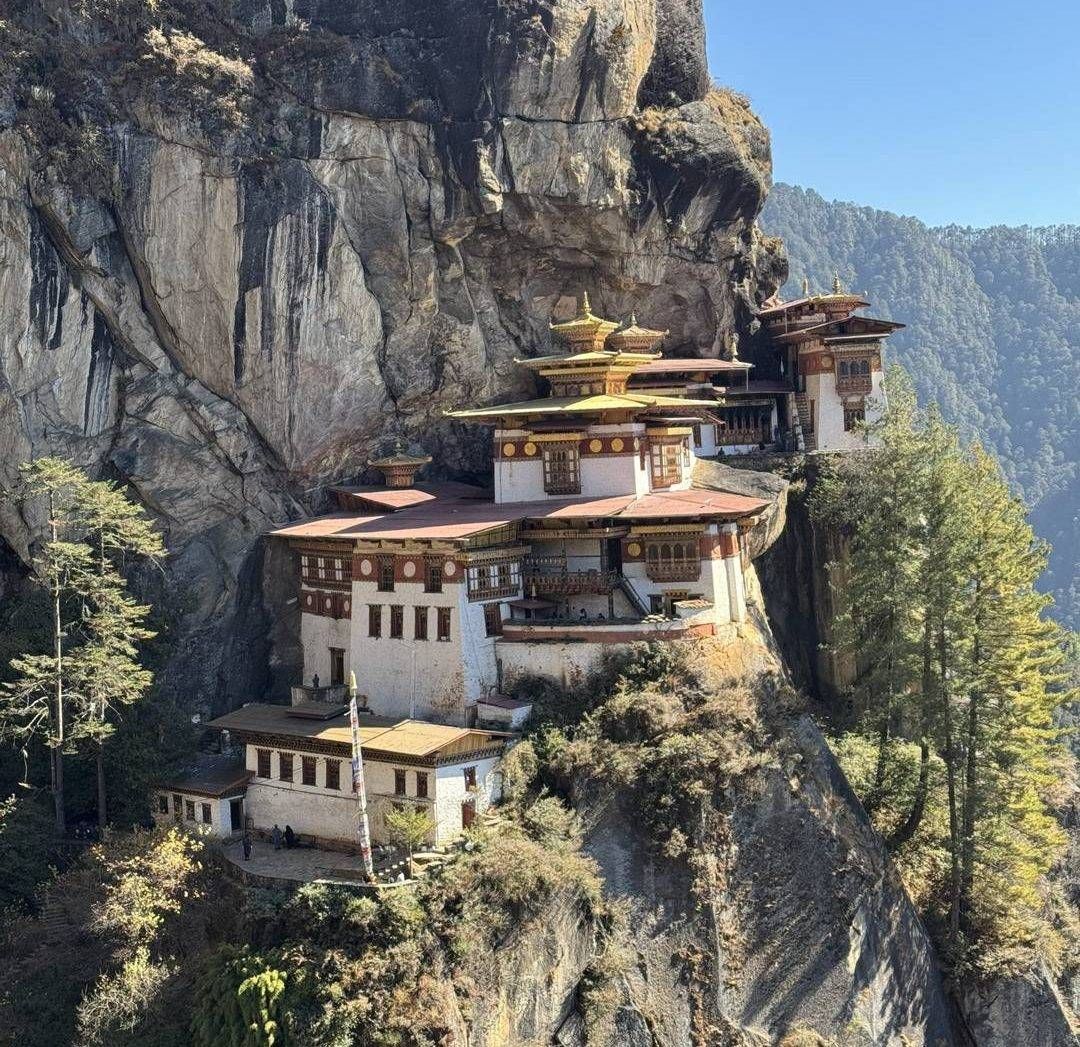
It wasn't as triumphant as climbing Mount Everest, but, for me, it was close – both literally and figuratively. I'm referring to the seven-hour hike I completed in early December on an adventure to the tiny country of Bhutan. Considered Bhutan's best trek and a must-do for visitors, the hike to Tiger's Nest Monastery, which is also called Paro Taktsang, is a strenuous 3,000-foot climb in the Paro Valley to a sacred site set along a sheer cliff.
While the Tiger's Nest's elevation is only one-tenth of Mount Everest's nearly 30,000-foot height in nearby Nepal, the monastery in Bhutan and the world's tallest mountain above sea level both sit along the Himalayas mountain chain. Completing the feat gave me a sense of accomplishment and wonder as it was both a physical and spiritual journey.
“I knew a tour of Bhutan would challenge me and I had a little under a month to get in shape for the difficult climb in the mountainous elevation.”
But how did I even get there? Bhutan is a faraway land from my home in Minnesota and honestly traveling there wasn't even really on my radar before I received an invite to stay at the Bhutan Spirit Sanctuary as part of a wellness vacation travel story. As the former health and wellness editor for Next Avenue, I knew quite a bit about wellness trends and various holistic retreats and have in the past traveled to Costa Rica and India to practice yoga and celebrated my 50th birthday scuba diving in Bali, Indonesia.
Despite my previous wellness trips and active adventures, that milestone birthday trip was six years ago and menopause and some extra pandemic weight had settled in. I knew a tour of Bhutan would challenge me and I had a little under a month to get in shape for the difficult climb in the mountainous elevation. I wasn't not going to do it, though. That would be like going to Paris but skipping a visit to the Eiffel Tower or journeying to Agra, India and not seeing the Taj Mahal. It had to be done.
Prayer flags on Tiger's Nest Trail
Along with applying for a number of different visas, arranging flights and excursions into and out of Bhutan and finalizing a number of other details with our licensed tour company, Himalayan Echoes, in the weeks before my husband and I set off, I added a daily walking routine around my home. Luckily, we had mild weather in Minnesota this fall and I didn't have to deal with icy sidewalks and snow to slow my progress. Those all came after my return home.
Buddhism and Gross National Happiness
I also started a daily practice of studying up on Bhutan and learning about the country and its culture before our weeklong visit. Friends often asked where Bhutan even is and what it is known for when I mentioned the trip: It's a landlocked country between China to the north and India to the south close to (but not bordering) Nepal. Its entire population is only about 800,000 people and its capital is Thimphu. There is only one international airport in Paro, about an hour's drive from the capital, and two official airlines, Drukair and Bhutan Airlines, so visitors flying into the country need to book flights on either of those airlines and there are only a handful of cities they fly into. We chose to fly from Delhi, India, but also priced flights to and from Bangkok, Singapore and Dubai.
Bhutan is a mainly Buddhist country and officially a democratic constitutional monarchy with a beloved king as the head of state – there are tributes and photos of the current king and his family everywhere – and a prime minister as the head of government. I had heard of Bhutan referred to "the happiest country in the world" but that's an oversimplification of the country's governing philosophy that measures residents' satisfaction.
Basically, instead of a gross domestic product (GDP) value that most countries use to measure their monetary value as a benchmark, Bhutan's fourth king (and the current king's father), Jigme Singye Wangchuck, conceived of a different index called the Gross National Happiness (or Gross Domestic Happiness) scale in 1972 that measures the population's happiness and wellbeing (there's that term again) as a whole. The concept stems from the country's Buddhist views of non-violence and compassion and was lauded by the United Nations General Assembly in 2011 and formalized in 2012 with the release of the first World Happiness Report.
A guide displays a memorial found along the trail
Of course, the Bhutanese people we met with enjoy talking about the report and concept but also admit there is always room for improvement as Bhutan opens its borders to tourists and slowly modernizes. One of our guides through Himalayan Echoes, Mani Inam, described life in Bhutan before the main highway connecting the few major cities in Bhutan's western region was improved in the 1960s and '70s. Then, residents used to travel via horses and mules and often would become very carsick their first few rides after the cars and trucks arrived.
Bhutan's focus on happiness and preserving its natural resources and culture also help guide its development and tourism policies, officially branded as "high value, low impact." One way Bhutan guards against overtourism is by requiring international travelers to obtain a visa and pay a $100 per day per person tariff – or sustainable development fee. The fee goes toward the country's education system and maintenance of extensive forests and natural resources.
Bhutan officially opened its borders to tourists only 52 years ago in 1974 as a way to raise revenue and recorded 287 tourists that first year. That number increased 20-fold by the end of the 20th century until the pandemic again closed Bhutan's borders and decimated the tourism industry. In 2022, the SDF dropped from $250 per day per person to be a bit more affordable for visitors, yet couldn't help but notice it seemed other visitors with their guides (who are required to wear the traditional Bhutanese dress of kira and gho when working) appeared to be wealthier visitors who can afford the daily fee over the college-aged backpackers hiking from hostel to hostel who are so common in other countries including Nepal. A week exploring Bhutan as a couple is an extra $1,400, not counting the lodging, dining and attraction costs.
“My husband and I did a 30-minute "Welcome to Wellness" consultation with a traditional Bhutanese medicine doctor who went over our diets, fitness levels and pain points.”
Welcome to Wellness
As the well-heeled visitors continue to add Bhutan to their travel itineraries, a number of luxury resorts and high-end hotel chains are investing in the area. Beyond the wellness and fitness trends, I learned from Audley Travel that another emerging way to explore the world is called "edgebound" travel to exclusive and remote locations. Bhutan excels at this and our three-night stay at Bhutan Spirit Sanctuary definitely fits this description.
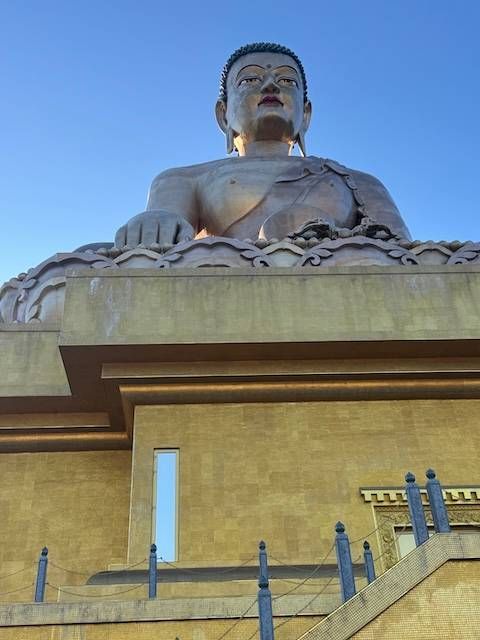
Billed as Bhutan's "first and only" five-star wellness-inclusive resort, the offerings here included free daily yoga and meditation sessions as well as one wellness spa activity per day. We experienced other memorable stays and authentic activities after Spirit Sanctuary through our tour with Himalayan Echoes, including a two-night homestay with a generous family on a working farm in a remote part of the country, a guided tour of the Punakha Dzong, a sunset visit to the "Big Buddha" statue or Buddha Dordenma in Thimphu, a private prayer flag-making session, and my husband's favorite, a round of golf at the Royal Thimphu Golf Course (where he was told members of the royal family were also hanging out in the pro shop that afternoon).
We knew we were going to hike Tiger's Nest on our third day in Bhutan, after we had adjusted to the elevation and recovered from our back-to-back overnight flights first to London and then Delhi. So on our first night at Spirit Sanctuary, my husband and I did a 30-minute "Welcome to Wellness" consultation with a traditional Bhutanese medicine doctor who went over our diets, fitness levels and pain points. Later that evening, we entered a darkened room and relaxed during a 45-minute sound treatment session that included the doctor playing chimes over my chest and passing crystal singing bowls over my limbs. The next morning, I attended the 7:15 a.m. yoga session before enjoying a hearty breakfast and returning to the spa an hour later for a 60-minute ku nye full body massage.
It was intense! My therapist was a small woman in her early 20s who surprised me halfway through the session by climbing onto my legs as I lay on my stomach for better pressure. That afternoon, we did a "practice" one-hour hike with our guide arranged through Spirit Sanctuary, Sonam Tobgyal Dorji, who I think was making sure we would be able to handle the Tiger's Nest hike. I was still pretty sore from the massage but appreciated the post-hike beer at the local brewery. The trial run also helped me realize I could use some walking poles and better shoes and to schedule a hot-stone bath at Spirit Sanctuary for the next day.
Tiger's Nest Challenge
On day three, we were up early to make the 45-minute drive from Spirit Sanctuary to the Tiger's Nest parking lot, which was already full by 9 a.m. with oversized vans full of hikers, their guides and their drivers. In early December, the weather was brisk but comfortable and the crowds were manageable. There were several spots along the path where we were the only hikers – but it was very crowded during peak session about six weeks earlier, our guide told us. I knew there was an option to ride a horse from the parking lot to near the halfway point of the hike – it's too steep of a climb for even horses after that point – but my guide strongly discouraged me from hiring a horse and splitting us up. He and my husband planned to hike the entire route. It was the right decision, both for bragging rights in the end that I did the entire climb unassisted and also for the uncertainty of my horseback riding skills.
While most guidebooks and online descriptions of the hike say the round-trip journey is about a 4- to 5-hour experience, I took my time resting often and stopping at the midpoint cafe on both the hike up and back for about 20 minutes each time. We also spent nearly an hour in the monastery learning about the lore of the cave where it was built in the 17th century. The tale is that Guru Padmasambhava, or Guru Rinpoche, reportedly meditated in the cave in the eighth century, riding to the remote cliff on the back of a tigress, which explains its namesake. Rinpoche is credited with bringing Buddhism to Bhutan, and the many shrines within the building explain the legend.
In the end, I realized I was only competing with myself to complete the hike and gave myself a lot of grace when I needed to rest. There's an optical illusion at the main lookout point where the cliffside monastery appears closer and larger than it is. I had read that there were nearly 800 steps to the monument, but I thought I had already completed them as part of the hike to that point. I was wrong, there were still nearly 400 steep steps down into the valley to a majestic waterfall and another 350 steps back up the other side of the cliff to enter the site.
I suddenly understood why the older couple we had met on the trail earlier said they didn't hike the entire trail, just the lookout point. "Why would you come all this way and not visit the monastery?" I had thought. That last quarter part of the hike (and the return) was the hardest of all but also very satisfying when I succeeded. And it's probably the closest I'll come to climbing Mount Everest.