

Some people love to go back to their favorite vacation spot year after year. Others are in search of something new and different every trip – once they have crossed off one location, they are on to the next. I'd count myself in that second camp because it's the novelty that excites me.
That's why several friends looked at me in disbelief when I announced I would be returning to India at the end of 2025. After a 10-day tour of Mumbai in 2017 as part of a birthday gift to myself, I said multiple times that I had no need to revisit the world's most populous country – there are plenty of other destinations around the world that I'd rather explore. I was overwhelmed by Mumbai's pollution, poverty and overpopulation. During that trip, I spent four hours in a taxi in choking air to travel 25 miles, suffered the "Delhi belly" food poisoning I had tried so hard to guard against and avoided eye contact with the monkeys in fear they would steal my purse or otherwise attack me.
“When the opportunity to travel to India again (and, remarkably, again over my birthday) came up, I seriously considered declining.”
My husband and I were visiting our son as he studied for a semester in Mumbai and had plenty to do in the southern region, so we didn't venture to other parts, but he did visit other cities as part of a unit studying the Ganges River and reported the air quality and cacophony of people were equally bad, if not worse.
Among the nearly 60 countries I have visited in my 56 years (many with the help of Rick Steves' guidebooks), India has been one of the most challenging to explore and enjoy; and I wasn't afraid to say so when asked for travel recommendations. When the opportunity to travel to India again (and, remarkably, again over my birthday) came up, I seriously considered declining. But, in hindsight, I'm very glad I didn't – the return trip helped me see the country a different way and with a more positive outlook.
A Deal to Delhi
The reason for the revisit was ultimately to get to neighboring Bhutan – a tiny country I knew little about other than its proximity to and positive relationship with India. Entry to Bhutan via the country's two official airlines is limited to a few international airports that those airlines fly into and out of, including India's capital of New Delhi.
After pricing out Dubai and Bangkok, my husband and I agreed on the Delhi destination and decided to extend our trip a few days for recovery after our exit from Bhutan. Arranging our visas to both Bhutan and India as well as getting my husband's passport renewed in the few weeks before departure required patience and perseverance, and my travel anxiety was heightened by my hesitation to revisit India.
“The Taj Mahal in Agra is a top choice on a lot of travelers' bucket lists and for good reason, it's spectacular.”
But I also had some optimism because we would be traveling to a different part of the country from Mumbai. I decided I needed to give it a "second chance," if you will, and work with a travel company to finalize the details instead of doing all the legwork myself. I reached out to Audley Travel, a respected luxury travel company I knew through some of my past travel stories and their experts helped arrange a trip to India's Golden Triangle area, the approximately 450-mile roundtrip route from the Delhi region, south from there to the city of Agra where the Taj Mahal is located and west from there to the desert city of Jaipur.
Amy Nelson with local women
Each leg is a long drive so a two- or three-night stay in each location is recommended; we had less time and completed the entire route in five days. Audley's 10-day Golden Triangle tour also includes two nights in Ranthambhore National Park to search for tigers and costs about $3,500 per person.
World Wonder
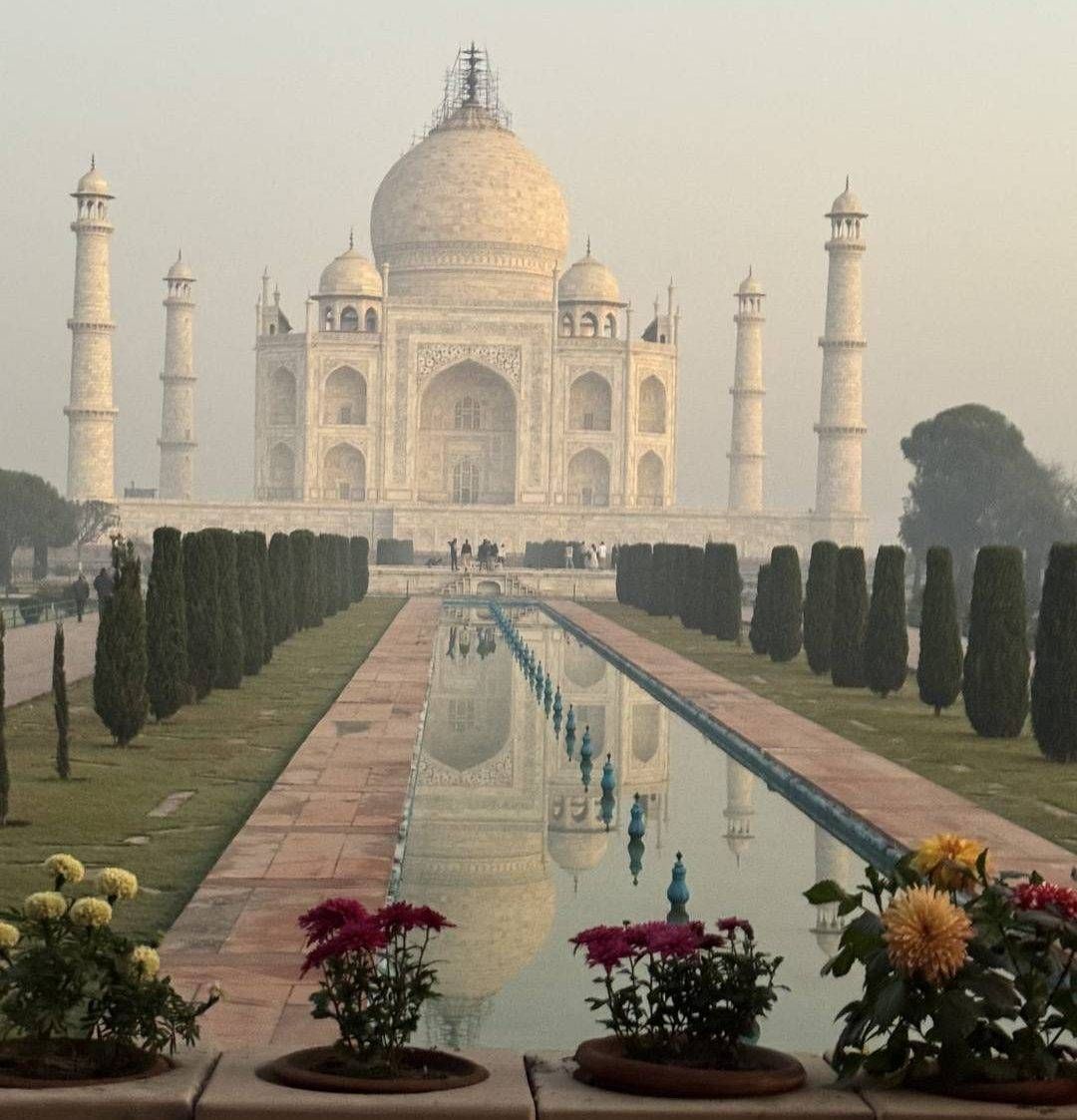
The Taj Mahal in Agra is a top choice on a lot of travelers' bucket lists and for good reason, it's spectacular. We started our Golden Triangle tour heading south to Agra after we landed at the Delhi Airport on a mid-week afternoon from Bhutan. Our driver was there to meet us at the airport and start the journey that had me thinking about the contrast in the air quality, serenity and natural beauty with Bhutan. (Bhutan wins.)
Arriving late that afternoon, we checked into our room at the Taj Agra. We wanted to catch the sunset from the hotel's rooftop infinity pool, which also had a view of the Taj Mahal opposite the red sun that was fuzzy and diffused from the gray air pollution. We walked around the neighborhood for an authentic meal along one of Agra's bustling streets and turned in early because we were scheduled to meet our guide the next morning at 5:45 a.m. in the lobby to visit one of the Seven Wonders of the World.
“I was impressed with the other tourists who patiently waited in line for the perfect photo without wandering into the frame or blocking the shot. ”
All the guidebooks and travel videos suggest getting to the Taj Mahal early because it opens 30 minutes before sunrise and attracts about 5 million people each year. We were there by 6 a.m. for the 6:30 a.m. opening and still about 40th in our line. Our guide said some visitors arrive by 4 a.m. to be among the first, standing in the chilly darkness. We chatted in English with others waiting and their guides and heard the rush of excitement as guards opened the gates. Our guide had already purchased us tickets and helped us through the security gates separated for men and women before making our way through the stunning gates to the large reflecting pools with the massive white marble mausoleum structure looming behind.
The stepwell outside of Agra
I was impressed with the other tourists who patiently waited in line for the perfect photo without wandering into the frame or blocking the shot. That unfortunately was the case a few hours later after the number of visitors increased tenfold.
Our guide filled us in on the history of the 42-acre complex, commissioned in 1632 by the Mughal emperor Shah Jahan to house the remains of his favorite wife, Mumtaz Mahal, who died in 1631 while giving birth to her 14th child. In the end, one of those sons killed his other siblings and deposed his father, the fifth emperor, to eventually become the sixth emperor. The family drama and intrigue was just a small part of the juicy details we heard during the tour. We learned more about the architecture, labor and materials as well. One of the benefits of visiting so early is we were back at our hotel for breakfast by 9:30 a.m. and on the road to Jaipur later that afternoon after a tour of the Red Fort.
Rural and Big City Surprises
Outside of Jaipur, we made a stop in the village of Abhaneri for a look at the well-preserved Chand Baoris or stepwell, a series of steep stairs that lead to a water well. It is one of India's largest and deepest stepwells and much more elaborate and impressive than the other stepwell we visited a few days later in the heart of Delhi.
“I got some major "White Lotus" vibes that evening when we checked into our accommodations for the stay in Jaipur: the Samode Haveli.”
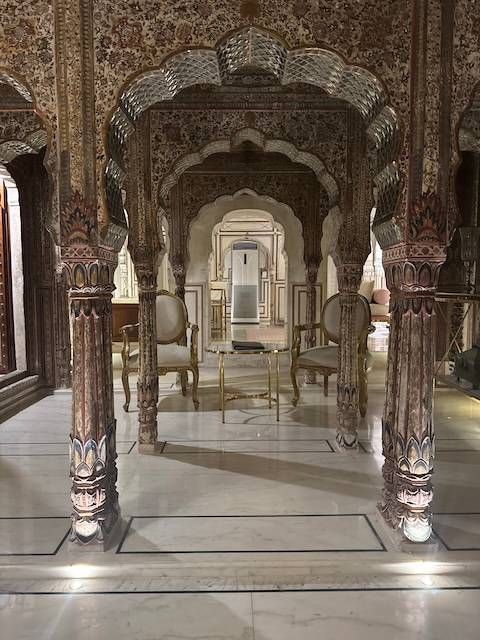
I got some major "White Lotus" vibes that evening when we checked into our accommodations for the stay in Jaipur: the Samode Haveli. Built 150 years ago by the prime minister of Jaipur, each of the hotel's 50 rooms is decorated in traditional style, with wall paintings, tapestries, mirrored tiles throughout to reflect the light and Rajasthani furniture. It was magical and we were totally content with staying in for the evening and eating dinner on the hotel's walled patio. It was lovely to return to the next night as well after a full day of sightseeing around Jaipur, including the Amber Fort Palace and a tour of the back-street markets.
The next day we were back on the road again with a five-hour drive back to Delhi. While it's only about 180 miles away, the last 90 minutes of the drive is jam-packed with cars, trucks, tuk-tuks, motor bikes, mopeds and the occasional cow weaving in and out of unmarked traffic lanes as we entered the region of approximately 26 million people. This is also when I had flashbacks of visiting Mumbai. When we pulled into the private and serene grounds of The Imperial hotel in the heart of the city, it was a relief from all the sounds, smells and surroundings. The remaining 36 hours in Delhi for me included a faith and food tour of Old Delhi, a walking tour of the public art displays in New Delhi, and a poolside drink while my husband golfed one of the public courses.
In the end, I think part of the reason this second tour of India was so successful was because I knew what to expect but a large part also has to do with Audley's expert guides and outstanding itinerary. I learned I should never say never to a return trip that may just offer plenty of new adventures.