

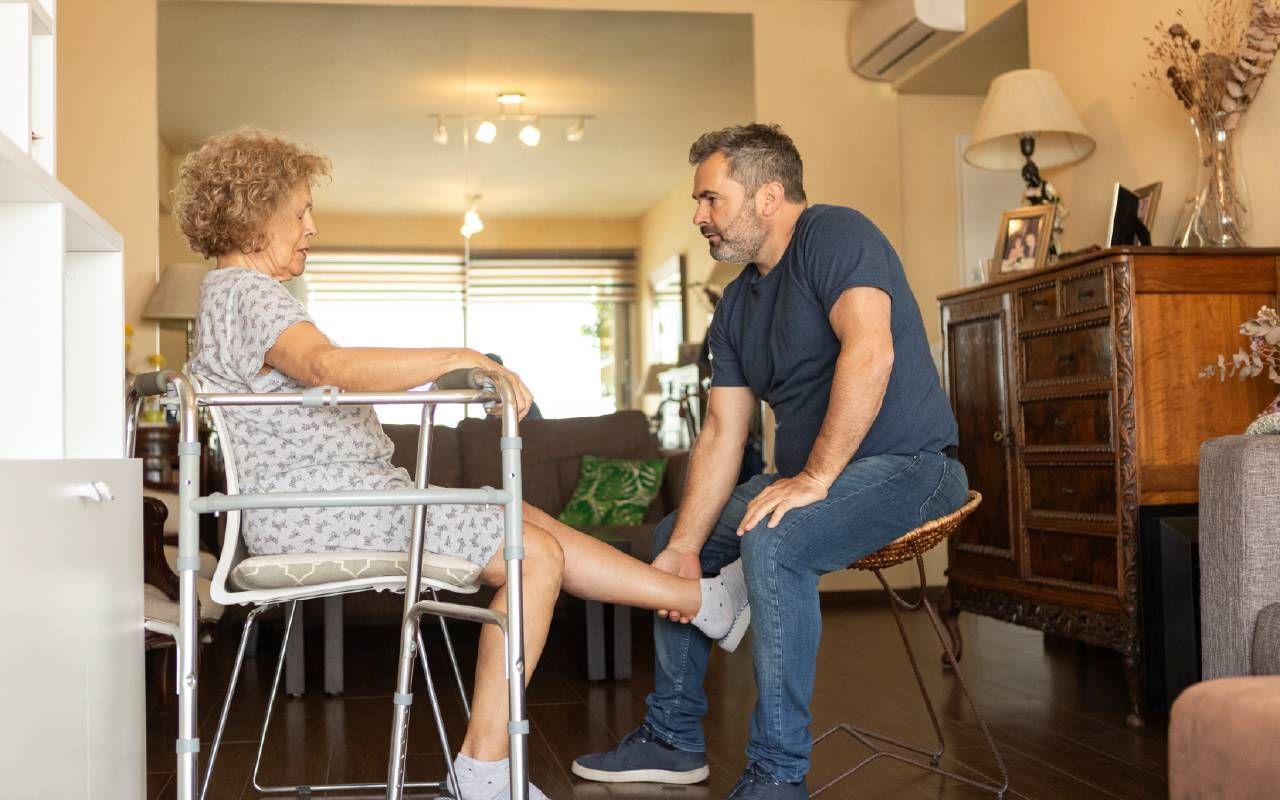
Joe Brancatelli is an organized guy. A longtime business journalist and frequent flyer, he is used to meeting deadlines as well as handling flight cancelations, aggravating seat-mates and harried hoteliers. But nothing quite prepared him for being his wife's caregiver after she was discharged from the hospital on the same day as her knee replacement operation.
As more joint replacements become outpatient procedures, caregivers like Brancatelli are being pressed into service in ways they did not expect.
Brancatelli and his wife, Joel Ann, both in their early 70s, live in a town about 50 miles north of New York City. They had initially planned on Joel Ann staying in the hospital overnight. But as Brancatelli sat in the waiting room after her surgery, a nurse announced that his wife was in the recovery room and ready to go home. Pumped up on pain medication, Joel Ann was feeling good. Brancatelli was nervous, but felt it wasn't his place to push back.
"I'm the support person," he says. "What are you gonna do, tell your wife no?"
So home they went. That's when his new job kicked in.
Brancatelli says the first 72 hours of being back home were brutal. "It's the most care required that you are least capable of doing," he says, including dispensing the highly addictive painkiller oxycodone. Their first professional caregiver didn't arrive for a few days. It was up to Brancatelli to make sure his wife received the medication when, the day after the operation, her pain hit eight out of 10 on the scale.
He hadn't anticipated the emotional punch he would receive at seeing his companion of four decades in so much pain, knowing he was responsible for fixing it.
Multiple Duties
He soon felt overwhelmed by a host of tasks that cropped up in addition to what he describes as his roles as nurse, companion and case manager. He was also "dietician, cook, cleaner, laundry service, and PR person. You're handling all the calls from friends and family members," he adds. "These are things that in the hospital are all handled by hospital staff."
He fell into bed exhausted at the end of each day.
"I recognize in retrospect why the caregiver looks worse than the patient," he says.
“I recognize in retrospect why the caregiver looks worse than the patient.”
Kate Granigan is a life care manager — a role formerly known as geriatric care manager — in Newton, Massachusetts. She says it's increasingly common for those undergoing hip or knee surgery to be released within hours. (According to New York's Hospital for Special Surgery, same-day hip and knee replacements are suitable for patients in generally good health, who have adequate support at home.)
While hospitals tout avoiding infection as an important reason for getting patients home as soon as possible, Granigan says there are other reasons patients might be sprung quickly, such as the increased cost to the hospital of an overnight stay.
"The insurance companies are in the business of getting people to spend the least amount of money," she says, citing Medicare Advantage as an example.
But hospitals are also grappling with a major issue unrelated to reimbursement: not enough beds. Stephanie Nothelle is a geriatrician and assistant professor of medicine at Johns Hopkins. "Beds are a scarce resource," she says, so hospitals seek to move patients along "as soon as is reasonable."
But this can put extra pressure on the caregiver once the patient is back home.
"Visiting nurses don't come for 24-48 hours," after a joint replacement operation, Granigan says. "They're not meeting you at the house or figuring out how to be in the house. There are so many pieces of it you are just not prepared for."
Feeling Unprepared
Brancatelli can attest to that. The main problem for him was the difference between the preparation he'd received at the hospital, and what actually happened. For instance, he knew his wife was going to be issued an electronic wound care device to keep her knee clean. A diligent researcher, he'd read up on the gadget ahead of time. But at the last minute he was told they'd be getting another device altogether.
"I didn't know how to work it, and it adds to the stress levels,' he says. "It was me and the nurse reading about it in the discharge area."
He praises the visiting nurses and physical therapists who came to the house in the days and weeks after his wife's operation. "All were excellent," he says. But different professionals showed up on different days, and each had their own way of doing things. "You have to adjust to them, not the other way around."
“The hospital provided Joel Ann with a patient 'boot camp' before her operation, so she'd know what to expect. Brancatelli says it should offer one for caregivers as well.”
The hospital provided Joel Ann with a patient "boot camp" before her operation, so she'd know what to expect. Brancatelli says it should offer one for caregivers as well.
Nothelle thinks this is an excellent idea. Even on its best day, she says, "the hospital doesn't do a great job at thinking about caregivers and giving them opportunities to practice all the different tasks they're going to have to do."
She describes the discharge process as often feeling "rushed" compared with other things the hospital does.
"There's a lack of a really solid, well thought-out system of including that caregiver. That piece of paper [handed out at discharge] is our system," she says. "It's not a great system."
Caregiver Tips
Brancatelli has advice for other family caregivers going into a situation like his.
He is adamant on one point. "Do not check out the same day," he says. "The day after the surgery is when the pain hits," leaving you, the caregiver, frazzled and upset at seeing your loved one suffer, while being solely responsible for bringing their pain under control.
Also, prod hospital staff. "You need to push every person in that process for what you will be required to do, and how you can prepare for that," he says. He says the staff at their hospital were great, "but [information sharing] is not what they're good at. They're good at taking care of the patient."
“Do not check out the same day. The day after the surgery is when the pain hits.”
He says caregivers should be ready to do tasks they are unfamiliar with, such as physical therapy and wound care, and recognize that things they know how to do, like cooking, may be more challenging than they think. He loves to cook, but found meal preparation tough because he was so busy juggling everything else.
The good news is that Joel Ann is doing very well seven weeks after her operation. Her hard work, and his, has paid off. She has stuck rigorously to her physical therapy regime and is now walking on her own. She just got the OK to drive again. Her surgeon is delighted with her progress, as is her husband.
But Brancatelli is still tired.
"I need a vacation," he says. "But then, so does she."