

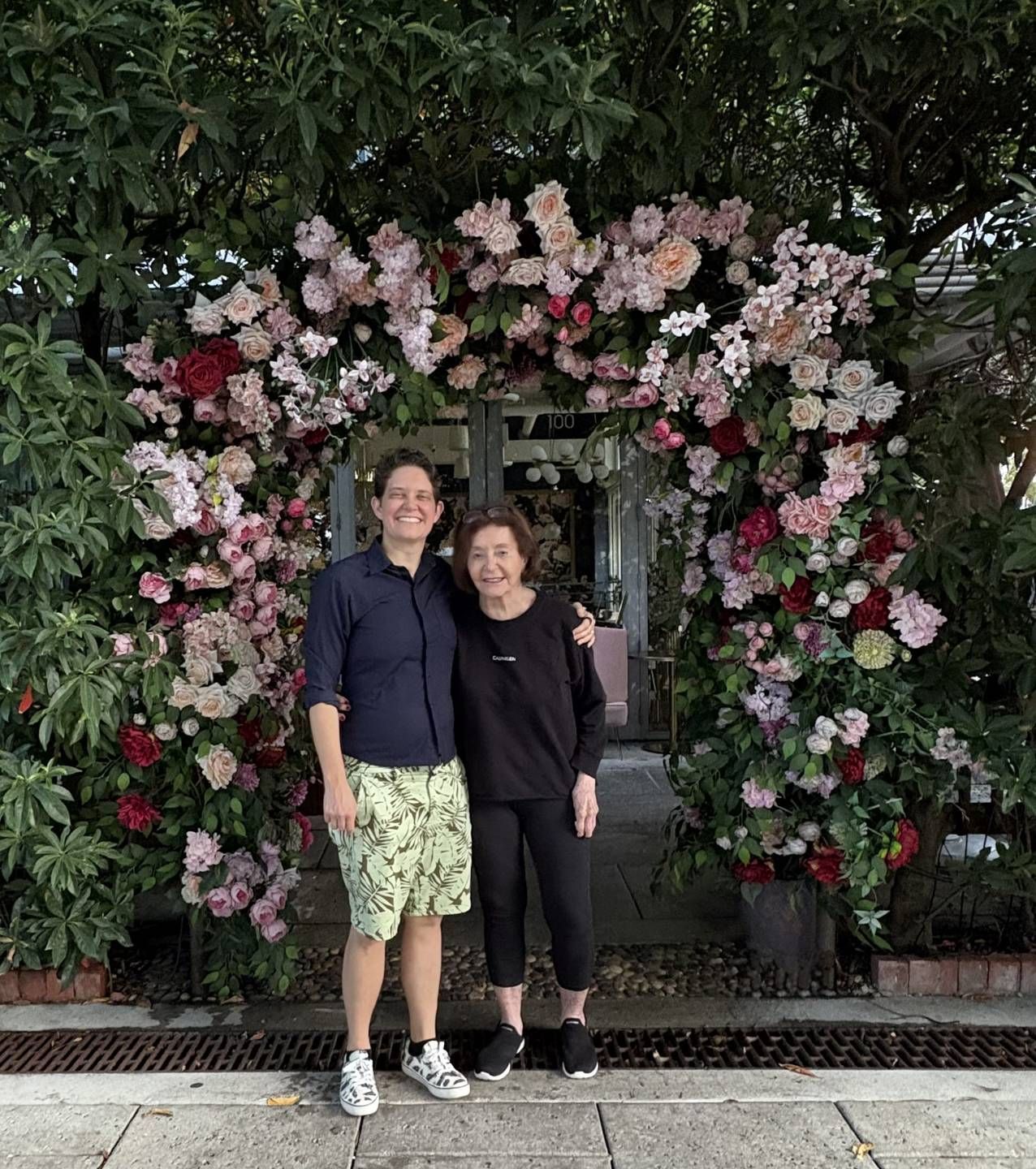
When the call came, Dorie Clark was 3,000 miles away. It was the end of April this year and Clark, a successful author, teacher and business coach, was at the start of a work trip in LA. She was on the phone in her hotel when another call popped up on her screen from a number in North Carolina, where her mom lives. But the number was not her mother's. She picked up and heard the voice of a first responder: her mother had collapsed at home and needed to be treated immediately. The situation was dire.
"I had talked to my mom just a couple hours before this happened and everything was totally normal," she says, "so the idea that potentially she could just die instantly was really terrifying."
It took Clark a torturous 24 hours before she finally reached her mother's bedside. Her mom Gail, who is 87, had suffered an aortic aneurysm dissection, which led to cardiac arrest. Clark and her wife Alexis moved into her mom's room in the critical care unit of the hospital, where they all spent the next 12 days.
“We wanted to understand, is is it a problem that they're not responding to or is it just like, you know, a normal thing?”
Her mom was semi-conscious and hooked up to multiple machines. Clark and her wife were sleep-deprived, and often felt anxious and helpless. Machines would sometimes erupt in a series of bleeps and they would panic, fearing a setback. But nurses didn't rush in, so maybe things were OK? They couldn't be sure, and the nurses weren't always available to ask.
This is when Clark decided to take matters into her own hands and fired up ChatGPT.
Pulling Up ChatGPT
"We wanted to understand, is it a problem that they're not responding to or is it just like, you know, a normal thing?" she says, "So AI actually became really helpful for us."
Here's how: Clark, who has the ChatGPT app on her phone, would snap a picture of the dashboard of the machine that was bleeping ominously, upload it to the app, and, giving some context on their situation, ask the app if what was shown in the photograph was a serious problem, or nothing to worry about.
"It would give us a sense of what was going on so that we were able to interpret these very complex charts that we didn't understand," she says.
There are, of course, caveats to using AI that we'll get into below. Clark was aware of those. But she says in a scary situation where hospital staff were busy, AI became a valuable resource.
“Our ability, even if we want to to sit down and have an hours-long conversation, is just limited.”
Different teams of medical staff came and went, but there was no point person from whom she could get an overarching picture. So she used ChatGPT again. There was fluid being drained from her mom's chest each day, but Clark had little sense of whether the rate of discharge was a sign of solid improvement, or not. So she took pictures, and asked the app to let her know, based on the photos, how much longer her mom's chest tubes were going to have to be in, "and it would provide us with information that could help us orient ourselves and ballpark her progress," she says.
She adds that most of the hospital staff were "terrific." But they were also "overburdened, especially in critical care."
Dr. Thomas Maddox is a professor of cardiology at Washington University School of Medicine in St. Louis. He's also vice president of the innovation lab at BJC HealthCare, and has spent much of his career looking at how technology can improve the delivery of care. (He had nothing to do with Gail Clark's care.)
"I think it's awesome," he says of Dorie Clark's AI-assisted patient advocacy. "I applaud her in being engaged." Maddox says AI will never be able to do everything a medically trained person can. Still, he agrees with Clark that medical staff are rushed. "Our ability, even if we want to to sit down and have an hours-long conversation, is just limited."
He says using AI to research your own or a relative's health is no different than using a book, or Google. But he says you should use the findings from ChatGPT (or any other Large Language Model) carefully. Which brings us to caveats.
AI and Privacy Concerns
Maddox says anyone who starts snapping pictures in the ICU risks coming up against data privacy concerns. "You wouldn't want to accidentally take a picture that had, say, a listing of all the other patients in the ICU in the background," he says. Doing so would violate those patients' right to privacy. He recommends asking medical staff for guidance before you take photos.
And it's not just others' privacy you need to protect. "If you don't want your data in the public domain, then don't be putting a bunch of information in these models [such as ChatGPT], either typing it, taking pictures, recording, any of that," says Maddox.
“If you don't want your data in the public domain, then don't be putting a bunch of information in these models [such as ChatGPT], either typing it, taking pictures, recording, any of that.”
When Clark was taking photos around her mother's bedside to upload to ChatGPT, she wasn't too concerned about keeping her mom's personal information obscured ("bigger fish to fry" she says). But she did make sure her privacy settings were set so that ChatGPT could not use the data she was uploading to train itself (in other words, that data wasn't being fed into the wider internet).
AI Is Not Always Accurate
AI can make mistakes. Just as you won't always get accurate information from a search engine, because those answers depend on the quality of its sources, the same goes for AI. Its information comes from the internet, and not all that information is good.
"I've seen ChatGPT incorrectly label medicines as a totally different medicine," says Maddox. Which is why, he says, it's "absolutely critical" to run your AI findings by medical staff and not assume those findings are correct. "Verify it with other websites, verify it with your care team," he says. Clark was alarmed when a ChatGPT check of her mom's EKG came back suggesting her mom was in atrial fibrillation. When a doctor looked at the results, he was clear: she wasn't.
But AI did help Clark communicate with her mother's medical team. She asked it for a list of questions to ask the team, based on her mom's vital signs. When she spoke, staff were impressed, she says. "On multiple occasions, the medical staff was like, 'Oh, do you have medical training?'"
Maddox says a well- informed family member is a benefit to the care team.
"I've got to say that family members who are very engaged are helpful to have because you can really partner with them," he says, as you bring a patient back to health.
"You just have to approach everything with humility," Clark says of combining her AI research with the medical team's expertise. "It's a sensitive situation. It's your loved one but you're treading in their territory."
After five weeks in the hospital and a few more recovering with Clark and her wife, Gail Clark is now back home.