

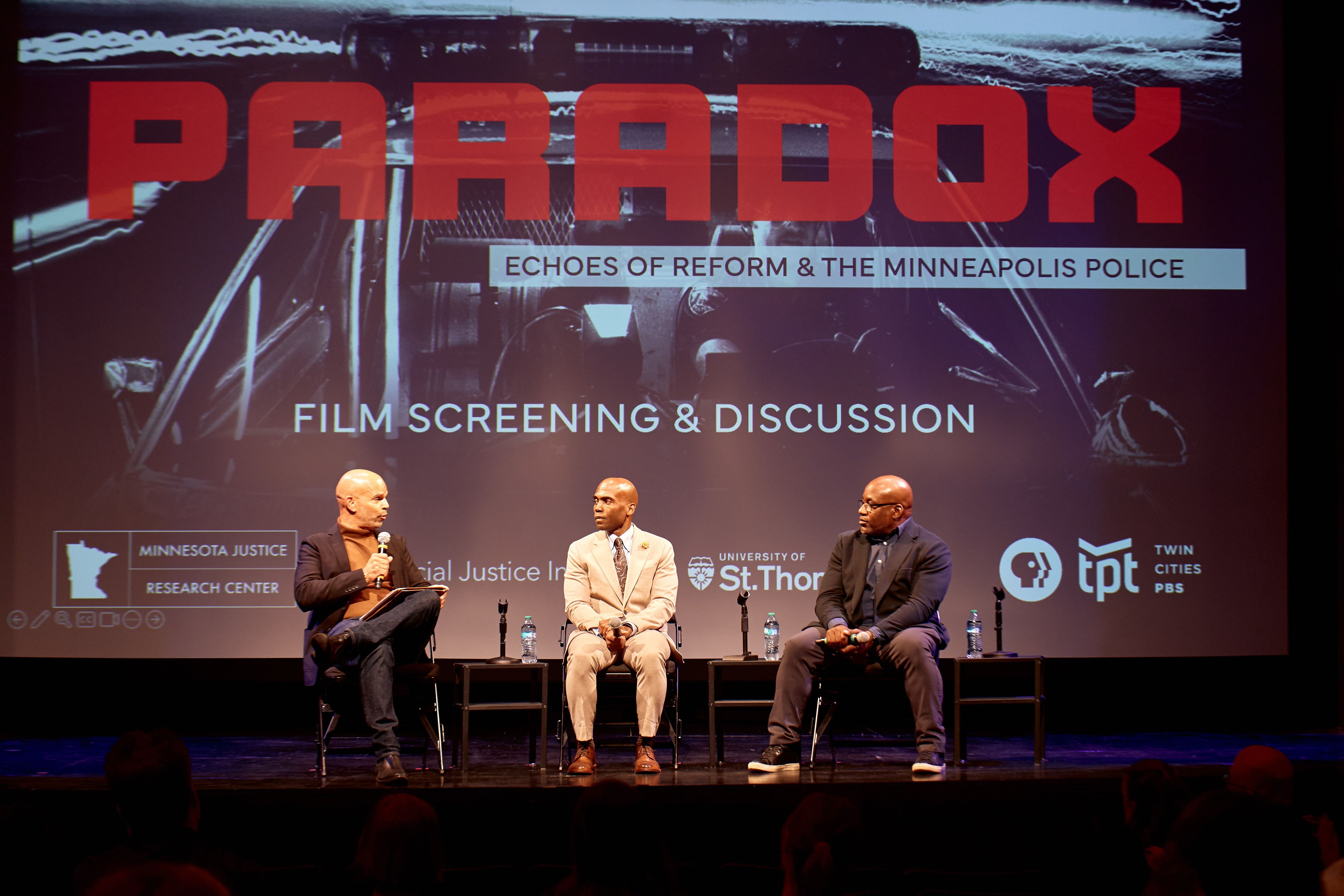
During my research for our documentary, “Paradox: Echoes of Reform & the Minneapolis Police,” I listened to numerous perspectives on what public safety means, from police chiefs and politicians to community activists and ordinary citizens. One of these perspectives that has been resonating with me is from Minneapolis Poet Laureate, Junauda Petrus.
In 2015, amidst the rising tide of deadly and high-profile police encounters across America, Junauda offered up a beautiful idea:
“Could we please give the police departments to the grandmothers?”
The protest poem-turned-picture-book offers a heartening ‘why not’ solution to one of the most complex and divisive issues of our time. It’s interesting that Junauda, poses this hopeful idea in the form of a question, inviting more inquiry, curiosity and creative thinking into a difficult issue.
Questions are also at the core of our documentary.
When George Floyd was murdered by Minneapolis police in 2020, the question “why Minnesota?” echoed across the globe. Among those asking this question was noted historian Dr. Yohuru Williams who had come to the Twin Cities to lead the Racial Justice Initiative at the University of St Thomas. He reached out to me and said he and his research partner, Dr. Michael Lansing from Augsburg College, were going to start a journey of historical recovery to probe the question of “why Minneapolis?” regarding police dysfunction through the lens of history. We agreed that a deep-dive documentary on the history of reform efforts and the Minneapolis Police Department (MPD) would be a useful addition to the urgent conversations about public safety that are fixated on the current moment. As Dr. Williams says, listening for ‘echoes’ of issues and their origins gives us context, data, perspective and history behind the headlines.
“Paradox” is based on the deep research led by Michael Lansing for his upcoming book on the history of reform and the MPD. In fact, Dr. Williams’s and Dr. Lansing’s research is a part of the story as we listen in on their thoughtful conversations and have our cameras present during their oral history interviews. The result might remind viewers of the PBS program “Finding Your Roots” as we combine a peek into historical research with rarely seen archival photos and footage, and bring it together with engaging storytelling that takes audiences along on a journey of historical recovery.
Personally, I love the reverie and joy found in memory and history. We have tried to bring this historical nostalgia to you through fun films like “Broadcast Wars,” “Remember the Magic” and “Lost Twin Cities.” But our mission at Twin Cities PBS also urges us to examine the difficult local history so that we can learn and grow from this awareness. In the tradition of other Twin Cities PBS history documentaries, we hope that “Paradox,” like “Jim Crow of the North” or “The Past is Alive Within Us,” will prompt constructive questions, reflections and conversations as it steps into the difficult and dimly lit century-plus history of police-community dynamics in Minneapolis.
But there is always hope.
I am reminded of Ophelia Rice, a Minnesotan and Black pioneer who is one of many community advocates featured in “Paradox.” Rice was a civic leader, mother and grandmother of a World War II veteran. She was also an early activist who stood up against police abuses at the turn of the last century. She was a grandmother who fought for her children’s right to be recognized fairly under the law. While recounting Rice’s history, I am again reminded of the words of Junauda Petrus, a poet who asks us to reimagine how we can keep our communities safe. Although there are over 100 years that separate these two women, the echoes of history continue to ring strong.
Watch all three episodes of “Paradox: Echoes of Reform & the Minneapolis Police” on TPT.org or the PBS App.